
The AI Bubble and Its Implications on the International Energy Sector
AI hype runs on power: data centers strain grids, capital consolidates, and energy becomes the real choke point when the bubble breaks.

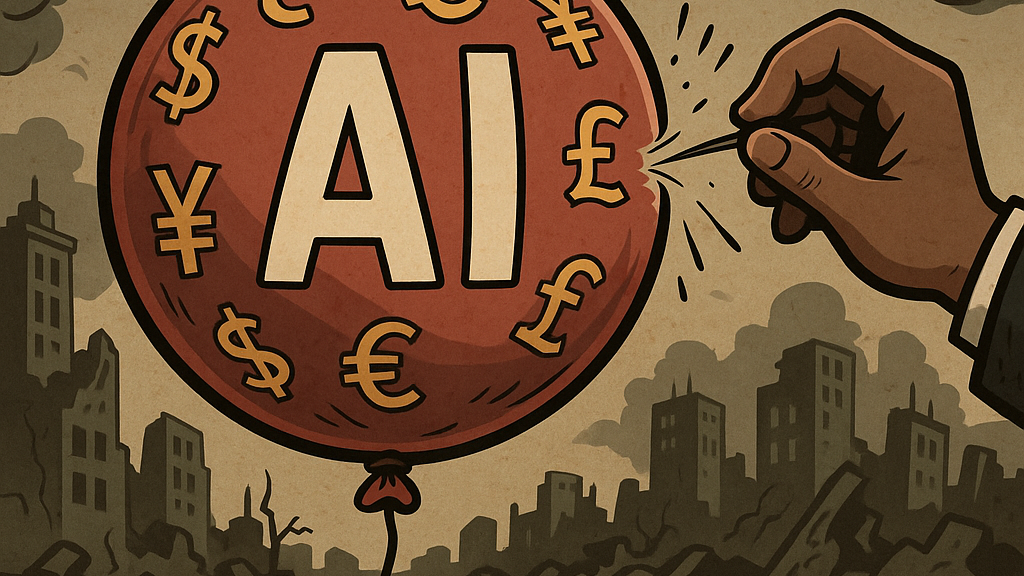
While reading Grace Blakeley’s article here, one might be convinced that the global economy is heading toward a major crash — perhaps the greatest we’ve seen in our lifetime. And maybe she’s right.
Over the last five years, markets have been accelerating toward monopolization, powered by what she calls the AI Circular Economy, a system where money moves in closed loops between the same few corporations, while the rest of the world supplies the electricity, minerals, and human labor to keep the illusion alive.
Billionaires and tech giants are buying up our infrastructure, our attention, and our future cashflow, while governments step back under the false promise of “free markets.” We’re witnessing a global takeover disguised as innovation, one where AI not only shapes production but perception too, dictating how we think, spend, and vote.
But let’s step back for a moment. Everything has a start and an end.
If this is a bubble, it will burst and like the dot-com boom before it, something will remain. The question is what. What will stay after the AI hype burns out? How will the energy that feeds this machine be produced, distributed, and stored? And for those of us with skin in the international energy game, what should we be betting on?
The Engine Behind the Illusion
Blakeley describes how firms like Nvidia, Oracle, and OpenAI are locked in a trillion-dollar money loop, investing in one another, reporting growth, and burning electricity to sustain the appearance of progress. Every dollar circulates between a few corporate silos, while the real cost such as power generation, materials extraction, grid strain, spills into the physical world.
The truth is simple. AI runs on energy. And right now, that energy doesn’t exist at the scale the system demands.
Data centers are being built faster than grids can handle them. Each one consumes the output of small power plants. The IEA estimates that global data-center electricity use could double by 2030, approaching 945 TWh, with AI as the main driver. No “renewables transition” can meet that curve without firm, fossil-backed capacity.
So while the tech sector markets “clean intelligence,” it’s feeding on the dirtiest and most geopolitically volatile commodity of all, energy itself.
From Green Transition to Compute Transition
In 2014, the oil crash redirected capital toward renewables. In 2022, the war in Ukraine turned “energy independence” into the next doctrine. Now, in 2025, we’ve entered the Compute Transition, where energy is no longer just for transport and homes, but for cognition.
AI is the new heavy industry. And like every heavy industry, it reshapes geopolitics.
• The U.S. calls it “national security” and subsidizes chips and power grids.
• China’s outstanding bank loans now exceed ¥268 trillion (≈ $36 trillion), with policy tools steering more of that credit toward tech and manufacturing.
• The Gulf states are converting hydrocarbon wealth into AI energy parks, exporting electrons instead of oil.
• And Europe is still quoting regulation while others build and finds itself watching from the sidelines again.
For Greece, this should sound familiar. LNG terminals, interconnectors, and subsea cables are rising on our shores, yet policy remains reactive, trapped between energy partners and digital dependencies. The infrastructure is here, but the vision isn’t.
The Upcoming Energy Bottleneck
If the AI bubble bursts, the energy infrastructure won’t vanish, but it will be under new management. Those who control energy density (production) and energy direction (distribution) will control intelligence itself.
Expect to see:
• Re-centralization of grids under “strategic resilience” policies;
• Private control of transmission and storage, disguised as “optimization”;
• Cross-border energy corridors tied to data-sovereignty agreements.
This means the energy market will not liberalize further, it will consolidate. And those without scale, especially smaller European utilities, traders, or independent producers will be absorbed or sidelined.
Meanwhile, the maritime sector, the artery of global trade and energy logistics, will be pressured to decarbonize while feeding a system that burns more electricity than it saves. It’s an absurd paradox, but one that benefits the few who set the new digital defaults.
The Human Equation
This shift also redefines labor. Operators, engineers, and planners, the people who keep the real economy moving, are being displaced by automation in the name of “efficiency.”
But efficiency for whom?
As Ilias Karavolias notes, beneath these flows of capital lies a new form of algorithmic Taylorism, where work becomes an act of signaling rather than producing. In the AI economy, energy substitutes labor, and data replaces judgment.
And when meaning disappears from work, consumption becomes the only proof of existence.
What Stays and What Matters
So back to the question: what will stay when the AI bubble bursts?
The same things that stayed after every bubble:
• The infrastructure, grids, cables, turbines, servers;
• The material backbone of intelligence, power and people;
• The countries that can balance both without losing control.
If there’s hope, it’s here, not in the speculative digital empire, but in the physical network that still makes it possible.
• Those who understand how to generate, move, and manage real energy will outlast those selling artificial ones.
When this cycle ends, the survivors won’t be the loudest innovators, but the quiet builders. The ones who still remember that nothing intelligent exists without power, and that power, in every sense, is still produced by human hands.
The message
The AI economy may be circular, but energy isn’t. Every loop has a cost that's physical, political, and human. When the circle breaks, those closest to the source of energy will be the ones still standing.
Dimitris Galantis has over a decade of experience in offshore energy and maritime operations, bridging hands-on industry knowledge with digital transformation and AI adoption. He is the co-founder and director of Intoolecta, a consulting firm focused on strategy, technology, and workforce solutions.
Ready to build what works
Let's talk about your operation and where structure can make the difference.
