
From Gas Fields to Green Grids | Understanding the Strategic Gameboard of the Eastern Mediterranean
Eastern Med power is shifting through gas, cables and offshore wind—law, migration and naval pressure decide whose maps hold.

When a foreign minister warns of "geopolitical cost" and likens a neighbor's diplomacy to a Pavlovian reflex, it is not just rhetoric. It is a signal. And in the Eastern Mediterranean, signals matter.
Earlier this week, Turkish Foreign Minister Hakan Fidan launched a highly charged critique of Greek political behavior, framing it as reactionary and opportunistic. More importantly, he warned of potential geopolitical consequences. This isn’t a slip of the tongue; it is an extension of a broader campaign. What we are witnessing is not isolated tension but part of a layered, long-term strategy to reshape influence, control, and narrative dominance in the Eastern Mediterranean.
A Layered Chessboard — What’s Really in Play
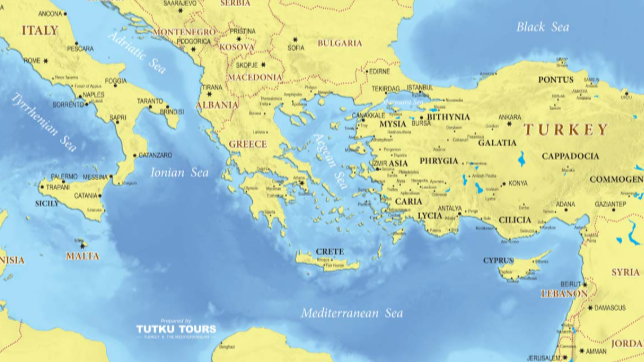
The Eastern Mediterranean is no longer a geopolitical periphery. It is a dynamic, multi-actor theatre where gas fields, submarine cables, data infrastructure, and competing maritime claims converge. To understand this region, one must map not only energy corridors but also migration routes, influence zones, and defense doctrines.
This isn’t just about Greece and Turkey. It’s about a shifting system. Here are the main vectors in play.
Turkey's Legal-Geopolitical Recalibration
Turkey’s “Blue Homeland” doctrine (Mavi Vatan) has redrawn Ankara’s perception of maritime sovereignty. The latest submission of a Maritime Spatial Plan to UNESCO dismisses the maritime rights of Greek islands such as Kastellorizo and Karpathos, located near the Turkish coast, and instead favors mainland-to-mainland median lines.
Turkey is also playing a multi-vector diplomacy game in Libya. In 2025, Ankara held high-level talks with both the Tripoli government and the eastern faction led by General Haftar—unusual bedfellows. The goal is clear: legalize Turkey’s maritime boundary claims via Libyan endorsement. A ratified Libya-Turkey MoU would create a legal facade for Turkish energy activities south of Crete, further undermining Greek maritime claims under UNCLOS.
Greece - Legalist Deterrence & Green Energy Push
Greece continues to hold the legal high ground, anchored in the United Nations Convention on the Law of the Sea (UNCLOS). Its EEZ agreements with Egypt and Italy are respected under international law, and its latest Maritime Spatial Plan filed with the EU seeks to align policy with legality.
Yet Greece is also quietly repositioning itself for the energy transition. Plans for floating offshore wind (FOW) infrastructure are underway across the Aegean and Ionian seas. These projects—if protected and permitted—could supply energy to millions. But they are strategically exposed: most suitable zones are adjacent to Turkish-disputed waters.
Israel - The Silent Power Broker
Israel holds a central position—geographically, energetically, and diplomatically. With Leviathan and Tamar among the largest gas fields in the region, Israel has both production and export capabilities. Exports to Egypt and Jordan are growing, and Tel Aviv increasingly sees itself as an energy corridor—not just a node.
Yet Israel is managing a crisis-prone perimeter:
• Hezbollah's activity in Lebanon threatens offshore gas platforms.
• Iran's shadow looms across Syria and the Red Sea.
• Domestically, the political and judicial crises have weakened consensus on foreign ventures.
Despite this, Israel continues strategic engagement with Greece and Cyprus. The EastMed pipeline may be stalled, but digital and electricity interconnectors remain part of a broader doctrine: build multiple paths to Europe, bypassing Turkish leverage.
Cyprus - A Sovereign Energy Hostage
Cyprus has confirmed reserves—Aphrodite, Calypso, Glaucus—but remains trapped between legality and strategic vulnerability. Turkey does not recognize the Republic of Cyprus and routinely challenges its offshore licensing rounds.
The Turkish-Cypriot north acts as a staging point for Ankara’s claim that any energy found must be “shared.” This narrative is now being internationalized. Even marine conservation zones have become weaponized—Turkey recently announced plans for “protected marine parks” inside areas licensed by Cyprus, blurring the lines between environmentalism and territorial assertion.
Africa - Source of Pressure and Opportunity
Northern Africa is not passive. Egypt is emerging as a central LNG hub, absorbing Israeli gas and re-exporting it to Europe. Algeria maintains leverage over southern European gas flows. Libya remains fractured, but highly courted.
The African dimension also includes destabilizing vectors: human trafficking, arms smuggling, and narco-routes all use maritime corridors across the Eastern Med. The refugee and irregular migration crisis—fueled by conflict, climate pressure, authoritarian regimes, and economic collapse—has become a geopolitical tool in its own right.
Turkey has repeatedly used migration as a form of leverage, threatening or enabling flows toward the Greek islands and the Evros border. It retains a strategic agreement with the EU, which provides funding in exchange for migration control. Yet, Ankara has shown its willingness to weaponize this pressure point during periods of diplomatic breakdown.
Greece absorbs the frontline burden, particularly on islands like Lesvos, Chios, and Samos, where reception capacity remains limited and public sentiment volatile. The refugee issue not only impacts internal cohesion but also acts as a soft underbelly in bilateral disputes.
Migration is no longer just a humanitarian or legal challenge. It has become part of the strategic arsenal—used to test borders, fragment alliances, and strain public trust in governance across the Eastern Med and the EU.
Russia, the U.S., and NATO: Ghost Players or Architects?
Russia continues to play spoiler, especially via naval deployments and energy diplomacy. While its Black Sea footprint is strained post-Ukraine, its long-term presence in Syria (Tartus naval base) keeps it anchored in the Eastern Med.
The U.S. underplays its hand publicly but is deeply embedded. Chevron is active in Israel. U.S. Navy operates with regularity through Crete’s Souda Bay. Washington favors regional balancing over intervention, preferring Greece, Israel, and Egypt to serve as a counterweight to Turkey without requiring direct conflict.
NATO remains paralyzed between its members—Greece and Turkey. The alliance's inability to mediate internal flashpoints weakens its coherence and leaves space for asymmetric escalations.
The Offshore Wind Equation | A Path Forward or Another Faultline?
The energy transition offers hope—but also complexity. Offshore wind projects in the Aegean, Ionian, and south of Crete are technically viable but strategically exposed.
Floating wind requires stable regulatory and geopolitical waters. In a region where maritime zones are disputed, cables can become casus belli. Infrastructure can be threatened—not by bombs, but by bureaucracy, lawsuits, or NAVTEX declarations.
Unless maritime jurisdictions are resolved, the green transition risks becoming just another theatre of confrontation.
Conclusion: The Real Gameboard
The Eastern Mediterranean today is not a battlefield of missiles, but a contested maritime chessboard—one where the pieces are legal doctrines, energy corridors, naval deployments, and information operations. Each actor has claimed a square. Each is testing the other's patience.
Greece remains anchored to international law. It publicly affirms its UNCLOS-aligned rights, while steadily expanding its offshore wind and interconnector ambitions. Its next move? Likely quiet diplomacy with EU energy players to shield infrastructure development through multilateral alignment.
Turkey is advancing not just with statements, but spatial planning, naval posturing, and narrative warfare. Fidan's rhetoric this week wasn't spontaneous—it was a placement of pressure. Turkey’s next move may come via NAVTEX, or a new MoU signature—legal gestures wrapped in strategic teeth.
Israel continues to play both anchor and conduit. Quietly supplying gas, digitally aligning with the EU, and deepening security ties with Greece and Cyprus, while bracing for fallout from northern threats. Its next move? Likely acceleration of alternative corridors—power and data—not necessarily pipelines.
Cyprus holds legal clarity but operational fragility. It remains isolated in its licensing efforts, hoping multinational partners will back its claims not just with capital, but presence. The next move may hinge on EU political will to counter Turkish pressure with strategic guarantees.
Egypt and Libya are wildcards. Cairo positions itself as a Mediterranean energy hub while carefully managing its alliances. Libya’s fractured authorities—courted by both Greece and Turkey—remain kingmakers for maritime legitimacy. Next move: Libya may ratify the Turkey-Libya MoU, triggering diplomatic escalation.
The U.S. and EU continue a calculated ambiguity. Both support de-escalation and energy diversification but stop short of confrontation. Their next move? Likely reinforcement of green infrastructure projects as stabilizing instruments, avoiding direct military entanglement.
This isn’t a game. It’s a configuration of power—one that will determine whose maps endure, whose cables land, and whose energy gets delivered.
In this chessboard of currents and cables, silence is strategy. But the next move will come—not from who speaks loudest, but from who places their infrastructure first.
Three Strategic Questions for the Reader:
• Can green energy stabilize a region that fossil fuels divided?
• Will power projection continue to override legal consensus?
• How do infrastructure and migration intersect in shaping maritime sovereignty?
The Eastern Med isn’t heating up. It’s transforming. From seabed to supergrid, this seems to be where the future of law, energy, and power will be contested—cable by cable, corridor by corridor.
Dimitris Galantis has over a decade of experience in offshore energy and maritime operations, bridging hands-on industry knowledge with digital transformation and AI adoption. He is the co-founder and director of Intoolecta, a consulting firm focused on strategy, technology, and workforce solutions.
Ready to build what works
Let's talk about your operation and where structure can make the difference.
