
Is it the End of the Decentralization Mirage? What Comes Next for Energy, Offshore, and the Global Order
Decentralization didn’t democratize power—it scattered it. AI and energy demand recentralize the world into blocs, corridors and scale.

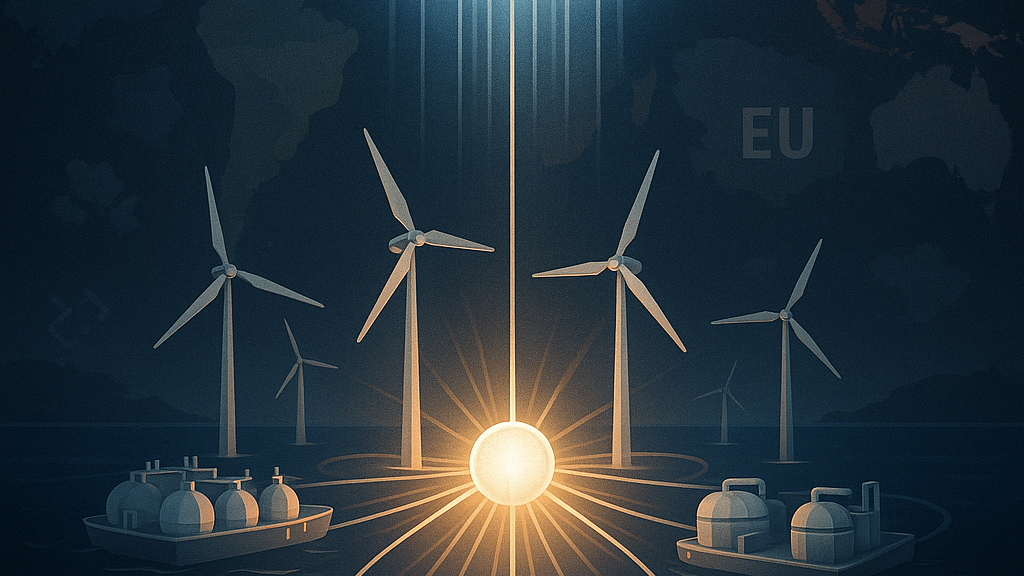
For years we were sold a simple promise: decentralization would empower individuals, disrupt old structures, and democratize systems.
Crypto, micro-generation, tokenized finance, Decentralized Autonomous Organizations (DAOs), peer-to-peer platforms, all marketed as the antidote to centralized power.
But across everything I’ve been watching the last years, from serious analysis by people like Grace Blakeley, to the work of thinkers like Ilias Karavolias, Paul Krishnamurty and investigating journalists like David Troy, to my own experience inside offshore and maritime — one outcome is now hard to ignore:
Decentralization didn’t democratize power. It scattered it — and the vacuum was captured by bigger players.
The recent turmoil in crypto is only a symptom. The deeper story is geopolitical, infrastructural, and energetic.
And it now reaches the heart of offshore energy.
Decentralization collapsed under the weight of scale
Crypto was the first stress test. It didn’t decentralize anything — it re-concentrated wealth into:
• a handful of exchanges
• a handful of custodians
• a handful of mining pools
And the same pattern repeated across every supposedly “distributed” sector:
• Cloud → now controlled by four hyperscalers
• AI → circular financing loops between Nvidia, OpenAI, Microsoft, Oracle, Amazon
• Social media → three platforms mediate the global public sphere
• Energy → still dependent on central grids, LNG import terminals, and state-level guarantees
• Semiconductors → dominated by Taiwan, the U.S., South Korea, and one Dutch lithography company
Decentralization failed for a simple reason:
Critical infrastructure does not decentralize. It centralizes — because capital intensity, efficiency of scale, and political protection reward size.
Energy, data, shipping, subsea cables, refining, shipyards — all of them tend toward concentration. There is nothing “distributed” about that.
The world is reorganizing into blocs | NATO, BRICS, and the new energy map
A German minister stated openly this month that Germany “may not be able to avoid conflict with Russia” if Ukraine collapses. This wasn’t political theatre — it was a structural admission:
Europe’s energy-security problem is now a geopolitical problem.
At the same time:
• BRICS expanded, integrating Middle Eastern and African energy producers.
• NATO’s center of gravity is shifting, influenced by U.S. elections and Turkey’s re-assertion.
• Russia & China are tightening logistics and energy routes across the Arctic and Central Asia.
• The U.S.–China maritime tariff war escalated, hitting global freight lanes directly.
This is not fragmentation. It is re-centralization — power clustering into competing macro-systems.
The decentralization narrative was built for the 2010s. The 2020s are an era of blocs, corridors, and state-level energy leverage.
AI energy demand is exploding, and only centralized systems can feed it
AI is physical, not virtual. Its appetite is growing faster than any civil infrastructure system can currently support.
Reliable data from the IEA, U.S. DOE, Fraunhofer, and EU grid operators confirm:
• Data centers already draw more power than many EU countries.
• AI-related load is projected to double global data-center consumption by 2030.
• The next generation of compute could require a Hoover Dam’s worth of electricity every year.
• Cooling water requirements are reshaping regional hydrology in the U.S., Europe, and the Gulf.
So, the key question emerges: Where will the energy come from?
Not from rooftop solar. Not from household batteries. Not from local micro-grids.
AI demand is industrial. It requires:
• LNG imports
• new nuclear capacity
• offshore wind scaled beyond failed 2023–2025 tenders
• HVDC interconnectors
• hydrogen/ammonia corridors
• subsea cables linking continents
• metals and refining capacity
All of this sits inside state-level, centralized, capital-intensive systems.
It’s not a libertarian ecosystem. It’s a geopolitical ecosystem.
Offshore will centralize further, not decentralize
Across my previous articles, the same pattern kept appearing:
Offshore energy is consolidating.
Not because the sector wants to, but because reality forces it.
Offshore energy requires:
• sovereign guarantees
• export credit agencies
• naval security
• global supply chains
• insurance capital
• multinational EPC contractors
• long-term power-purchase agreements
As tenders fail in Germany and the Netherlands, as Ørsted recapitalizes, as cost inflation hits steel, turbines, and vessels, the offshore sector is becoming more dependent on bigger players.
Small operators are being squeezed out. Medium operators are being absorbed. Large operators are becoming infrastructure arms of states and sovereign funds.
Offshore is not decentralizing. It is hardening into state-aligned industrial clusters.
Decentralization died because it depended on central systems anyway
This is the part most people still refuse to accept:
• Crypto depended on central banks and regulated exchanges.
• Web3 depended on Amazon, Google, and Microsoft data centers.
• Home solar depended on lithium refining controlled by China.
• Battery storage depended on cobalt supply chains in Congo.
• Micro-grids depended on national grid stability.
• AI depends on gigawatt-scale energy systems.
Every decentralized dream relied on a central backbone it could not influence.
When the backbone tightened, the ideology collapsed.
What survives after decentralization fails?
Just like the fiber-optic cables that survived the dot-com collapse, the infrastructure built during the AI boom will remain:
• hyperscale data-center parks
• offshore wind clusters
• nuclear restarts
• LNG import terminals
• hydrogen/ammonia hubs
• battery and chip mega factories
• new shipping corridors (Arctic + East Med)
• deep-sea subsea cable routes
This is the infrastructure that will define the next 30 years.
Tokens won’t matter. Speculative decentralized finance won’t matter. Narratives won’t matter.
Physical systems will matter. And physical systems do not decentralize.
The message
Decentralization didn’t fail because it was naïve — it failed because the world is shifting into an era where scale, sovereignty, and energy dominate everything.
Here’s what should come next:
• Offshore energy will consolidate, not diversify. Large sovereign-backed clusters, fewer developers, tighter lending, and tenders redesigned for scale. Offshore becomes an industrial-policy tool, not a “market.”
• AI will reshape energy demand faster than renewables can respond. Data centers, LNG imports, nuclear revivals, and new HVDC corridors will drive the map. This is industrial energy — not household decentralization.
• Geopolitics will move around corridors, not ideology. NATO hardening its south, BRICS tightening logistics, U.S.–China tariffs rewriting shipping lanes. The world is reorganizing into competing blocs.
• The new divide is energy literacy. Those who understand grids, offshore cycles, and maritime choke points will navigate the decade. Everyone else will be spectators.
The bottom line: Centralized infrastructure — not decentralized ideology — will define the next 30 years. The question is whether Europe adapts in time… or gets written out of the map others are already drawing.
Dimitris Galantis has over a decade of experience in offshore energy and maritime operations, bridging hands-on industry knowledge with digital transformation and AI adoption. He is the co-founder and director of Intoolecta, a consulting firm focused on strategy, technology, and workforce solutions.
Ready to build what works
Let's talk about your operation and where structure can make the difference.
