
From Oil Crash to AI Hype: What Offshore Energy Teaches Us About Real Transitions
Offshore energy shifts via crises—not slogans. From 2014 oil crash to AI hype, bankability still depends on people, rules, capital.

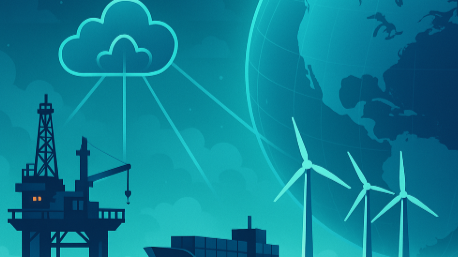
Buzzwords vs. reality
We like big words in this industry: transition, transformation, disruption. But offshore energy doesn’t move because of slogans. It moves because of crises, capital, regulation, and people adapting under pressure.
I’ve seen this firsthand — from recruitment floors during the 2014 oil crash to today’s debates about AI.
2014 Oil crash, Crimea, and the labor crisis
In 2014, oil prices collapsed by more than half in a few months. At the same time, Russia annexed Crimea, forcing Europe to confront its energy dependence.
Capital drained from offshore oil & gas and started flowing into renewables. Offshore wind, until then a fragmented niche, became Europe’s new frontier.
But there was one problem: no workforce existed.
• Dredging crews, used to building islands in the Gulf, were suddenly loading turbine foundations in the North Sea.
• Oil & gas engineers, laid off in the downturn, were retrained to lay cables or supervise offshore lifts.
• Recruiters like me spent hours persuading candidates: “Your crane experience counts, even if the turbine job title is new.”
This wasn’t a polished “energy transition.” It was a labor crisis, patched with improvisation. Messy, but it worked.
2015 The Paris Agreement and the ambition gap
If 2014 was about improvisation, 2015 raised the stakes. The Paris Agreement bound Europe — and much of the world — to targets that made offshore wind not just desirable, but unavoidable.
On paper, it was a transformation: climate goals written into treaties. In practice, it created an ambition gap. Governments raised targets faster than ports, grids, and supply chains could expand.
This widened the tension we were already living: crews and contractors adapting on the fly, while policymakers wrote roadmaps that assumed mature systems existed. They didn’t. Offshore wind was still fragmented, still building its standards, and suddenly expected to become Europe’s energy backbone.
Dredging pragmatism meets wind bureaucracy
Dredging was pragmatic, even cowboy-like — few global standards, lots of project-level problem-solving. Offshore wind felt different: fragmented permitting regimes, subsidy-driven, cautious investors, and heavy bureaucracy.
We funneled the rough pragmatism of dredging and oil & gas into a rule-bound, subsidy-backed framework. That culture clash shaped offshore wind’s early years — and still echoes today.
2016 GDPR and the compliance crisis
By 2016, the GDPR forced offshore recruiters and contractors to overhaul how they handled data. Candidate CVs, crew certificates, compliance records — all had to meet strict privacy rules, with penalties in the millions.
This wasn’t about IT. It was about survival. If you couldn’t prove compliance digitally, you lost contracts.
That was the compliance crisis. And it showed how software and regulation become invisible funding engines: without them, capital won’t flow.
2020 COVID and the resilience crisis
COVID slowed projects but didn’t break offshore energy. Crews adapted with quarantine rotations and remote tools. Installations dipped, then recovered. The industry proved resilient.
This was the resilience crisis: not about capital or compliance, but about whether the industry could keep operating under global disruption. It did.
2022 Ukraine and the security crisis
Russia’s invasion of Ukraine jolted Europe’s energy system again. Gas dependency had to be cut fast. LNG terminals were rushed into operation in Greece, Poland, Germany. Ports like Alexandroupoli became strategic overnight. East Med geopolitics returned to the spotlight, with Cyprus, Israel, and Egypt entering Europe’s gas map.
Capital followed security. Billions were redirected into LNG, pipelines, and interconnectors. Offshore wind targets grew on paper, but immediate money went where security demanded it.
This was the security crisis: when politics dictated investment flows.
2025 AI hype and the economics crisis
Today, the crisis is economics.
• Project costs have surged — turbines, vessels, steel, finance.
• Interest rates of 4–5% have broken old project models.
• Tenders in Germany and the Netherlands have failed or been postponed.
• Ørsted raised nearly €9 bn in new equity, backed by the Danish state, after U.S. setbacks.
• And in the U.S., projects have even been canceled mid-construction — shaking investor trust globally.
This is the economics crisis: offshore wind’s flagship model is under pressure.
And this is where AI collides with the anxiety. It’s being pitched as the lever to restore bankability: compress schedules, reduce downtime, cut OPEX.
• AI transition = copilots that draft reports, optimize routes, or improve forecasts. Incremental, practical.
• AI transformation = rebuilding entire planning, compliance, and trading systems around AI. Possible, but distant — and only if regulators, financiers, and crews trust it.
The question is the same as in 2014, 2016, and 2022: does this solve the crisis at hand?
The message
Looking back, the pattern is clear:
• 2014 — Labor crisis: Oil crash + Crimea pushed people into wind.
• 2016 — Compliance crisis: GDPR forced digitalization to keep contracts.
• 2020 — Resilience crisis: COVID tested continuity at sea.
• 2022 — Security crisis: Ukraine redirected capital to LNG and grids.
• 2025 — Economics crisis: Cost blowouts and politics test offshore wind’s viability.
Each time, the industry adapted. Not through buzzwords, but through people, regulation, and capital finding new alignments.
That’s the lesson: transitions are messy responses to crises; transformations stick only when systems, regulation, and funding catch up.
So when we talk about AI today, let’s cut through the hype. Offshore energy doesn’t need promises of disruption. It needs tools that deliver bankability under pressure.
Because in the end, energy transitions don’t live in hashtags. They live in ports, vessels, grids, and crews — adapting, again and again, to whatever the world throws at them.
Dimitris Galantis has over a decade of experience in offshore energy and maritime operations, bridging hands-on industry knowledge with digital transformation and AI adoption. He is the co-founder and director of Intoolecta, a consulting firm focused on strategy, technology, and workforce solutions.
Ready to build what works
Let's talk about your operation and where structure can make the difference.
