
Ports, Politics, and Patience: The Hidden Energy Map of Greece
Greece’s energy future is shaped by ports, grid limits and Turkey disputes; LNG buys time while offshore wind stays stalled.

The Energy Crisis Is European, But Greece Is a Test Case
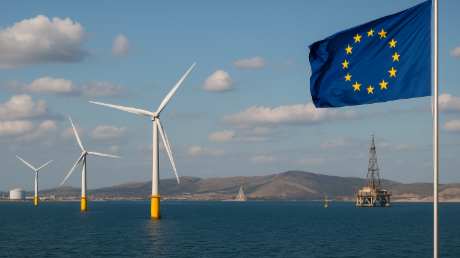
Europe’s offshore wind sector has been rattled this summer by failed auctions in Germany, capital calls at Ørsted, and a broader investor retreat from “zero-subsidy” dreams. These are not isolated hiccups — they show a system under strain.
Greece, meanwhile, sits on the sidelines: rich in untapped wind and gas potential, strategically located between Europe, the Middle East, and North Africa — yet still without a single offshore wind project in construction. The gap between geography and reality is widening.
The Ports Tell the Story
• Alexandroupoli: transformed by the Ukraine war into a logistics hub for U.S. LNG and NATO deployments. It shows how ports in Greece are not just about commerce — they are about alliances and sovereignty.
• Elefsina & Syros: shipyards with the potential to feed offshore construction, but starved of consistent investment and industrial planning.
• Piraeus: the flagship port under Chinese control, symbolizing how Greece’s critical infrastructure is already entangled in global competition.
These are not just harbors. They are chess pieces on Europe’s energy board.
Turkey in the Equation
No analysis of Greece’s energy map is complete without Turkey.
• Ankara contests maritime zones under UNCLOS, directly shaping where Greece dares to license offshore projects.
• Turkey’s 2019 MoU with Libya redrew maps in ways Brussels rejects but cannot ignore.
• For investors, this is not a legal footnote — it’s geopolitical risk, and it chills confidence in projects near contested waters.
The Grid: A Hidden Constraint
Ports and turbines get attention, but the electrical grid is just as critical.
• Island bottlenecks: Many Greek islands still rely on expensive diesel generators. Subsea cable projects (Cyclades, Crete–Attica) are ongoing, but the system remains fragile and delays are common.
• Export corridors: Greece is well-positioned to become an energy bridge between the EU and neighbors. There is already one 400 kV interconnection with Turkey, part of Europe’s synchronous grid. A second, 2 GW line is planned for 2029, which could double capacity and anchor Greece more firmly in regional energy trade.
• The gap: Until these upgrades are in place, Greece cannot integrate large volumes of offshore wind, even if projects were ready tomorrow.
The grid is the invisible skeleton of the energy transition — and Greece’s is still too weak for the weight it is expected to carry.
The LNG Bridge and the Offshore Delay
While Greece talks offshore wind, its actual role in Europe’s crisis is different: as an LNG gateway.
• U.S. LNG landed in Alexandroupoli, Revithoussa, and future terminals is cushioning Europe’s gas crunch.
• But the more LNG dominates, the less urgency Athens shows in unblocking offshore renewables. The LNG bridge, while vital, is buying political time — and political time often means lost industrial momentum.
The Wider Crisis Context
The Trump–Putin summit in Alaska briefly lowered European gas prices, but produced no real shift in supply. The EU remains structurally dependent on imported gas and imported renewable hardware, with fragile grids and delayed permitting.
This is why Greece matters. Its position at the crossroads of EU corridors, NATO logistics, and Mediterranean disputes means its delays are not just local inefficiency — they are part of the wider European vulnerability.
Patience, But No Complacency
Greece has the wind, the ports, and the maritime know-how. What it lacks is:
1. Regulatory clarity (auction timeline, spatial planning, grid access).
2. Industrial strategy (shipyards, ports, training pipelines).
3. Diplomatic insulation (credible frameworks to manage EEZ disputes with Turkey).
Without these, Greece risks being a corridor for other people’s energy rather than a producer of its own.
The Map We Don’t Talk About
The hidden energy map of Greece is not a colorful grid of future turbines. It is a web of ports, pipelines, cables, alliances, and contested waters — all shaping Europe’s options in the age of crisis.
The lesson for Europe is clear: ambitions announced in Brussels mean little if the southern flank remains trapped between LNG dependency, grid fragility, geopolitical ambiguity, and regulatory inertia.
Greece can still move from corridor to contributor. But that will require politics as deliberate as the winds are strong.
Dimitris Galantis has over a decade of experience in offshore energy and maritime operations, bridging hands-on industry knowledge with digital transformation and AI adoption. He is the co-founder and director of Intoolecta, a consulting firm focused on strategy, technology, and workforce solutions.
Ready to build what works
Let's talk about your operation and where structure can make the difference.
