
The New East Med | LNG, Narratives and the Return of Power Politics
AI demand revives LNG geopolitics: Europe scrambles, NATO hardens energy corridors, and Greece becomes a corridor—not a power.

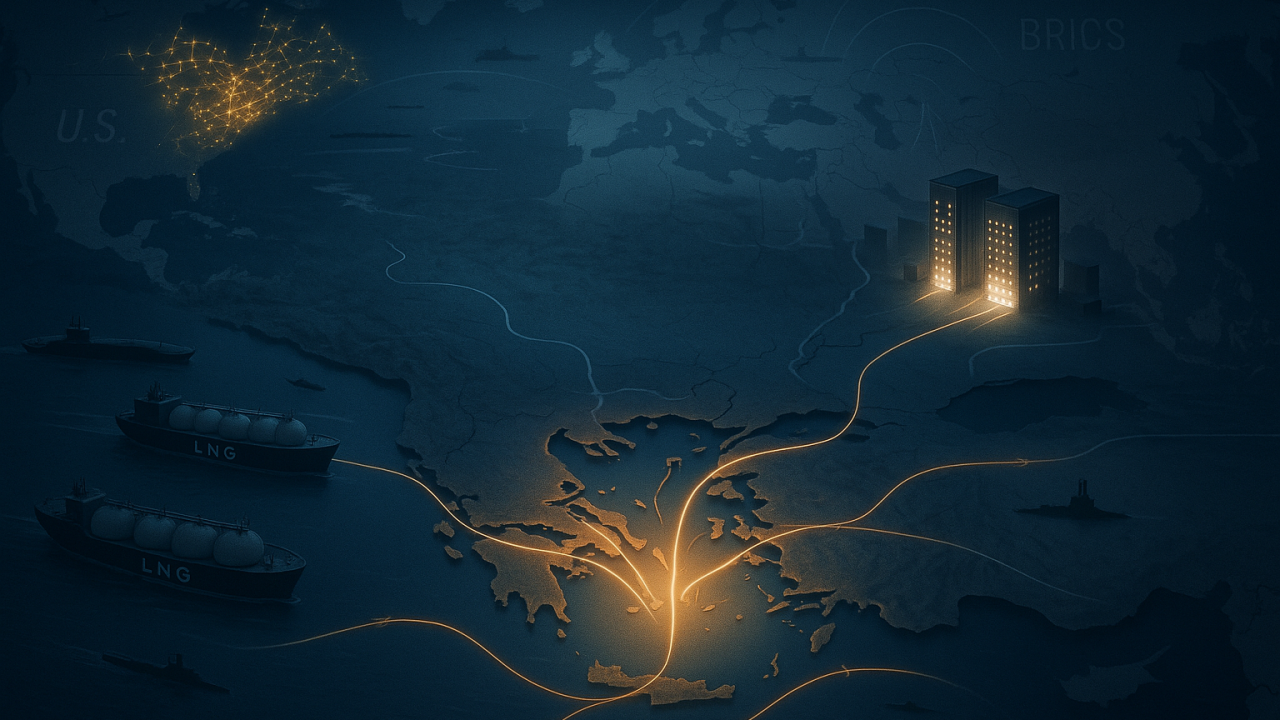
We live in a global economy where reality no longer leads — narrative does. Markets no longer wait for production, demand, or stability. They price the future story long before the present catches up. That is how AI companies reach trillion-dollar valuations without sustainable revenue. That is how “green transition” industries attract capital well before their technologies mature. And that is how countries, pipelines, and LNG terminals become geopolitical assets before anything is even built.
Capital today monetizes future scarcity and future intelligence. It doesn’t care if the systems underneath actually work. And when nations operate with the same logic, you get the world we’re living in, a planet running on promises, not infrastructure, and alliances designed around fragility rather than confidence.
Nowhere is this clearer than in the collision between AI and energy.
AI Didn’t Just Change Technology — It Changed Electricity
Behind every AI model sits a data center consuming electricity like a mid-sized city. Europe assumed it had time. It assumed renewables, grids, and storage would grow at a predictable pace. It assumed nuclear could be paused without consequences. And it assumed Russian gas was permanent.
Every one of those assumptions collapsed.
Europe now faces a structural crisis:
• a nuclear gap that won’t close before 2035,
• the permanent political death of Russian pipeline gas,
• renewables without storage,
• grids unable to absorb sudden spikes or heatwaves,
• and a surge in AI-driven electricity demand that no one prepared for.
AI didn’t just disrupt software — it exposed Europe’s energy insecurity.
2025–2035 | Europe’s Decade of Energy Panic
With Russian flows gone, nuclear late, storage immature, and grids overstretched, Europe did what desperate systems always do: it turned to LNG — not because LNG is the future, but because it exists today.
But this scramble doesn’t happen in a vacuum. It happens in a world splitting into energy blocs.
BRICS is building its own oil, gas, currency, and logistics ecosystem. China is locking down Gulf energy flows. India is securing long-term Russian supplies. The Middle East is tilting toward the yuan. The U.S.–EU axis is responding by reinforcing its own energy corridors.
The LNG corridors through the East Med are not just commercial. They are part of a global contest between competing energy orders.
Temporary scarcity creates temporary winners. And geography suddenly becomes destiny.
This is where Greece re-enters the map...
Greece | From Periphery to Corridor
Greece is not becoming an energy power. Greece does not control production. Greece does not shape final demand.
But Greece controls routes and in a fragmented geopolitical landscape, routes matter more than ever.
Transit states matter not because they create value, but because someone else’s value must pass through them. That’s the quiet logic behind LNG terminals, FSRUs, regasification facilities, interconnectors, and the rising naval interest in the Eastern Mediterranean.
Europe doesn’t trust the rest of the East Med:
• Israel is locked in conflict.
• Cyprus is blocked by Turkish vetoes.
• Egypt is collapsing under domestic shortages.
• Lebanon is structurally non-functional.
• Turkey is strategically vital but politically unpredictable — a NATO member that plays both sides between Washington and Moscow.
So, the West does what empires always do: it builds around the problem.
It bypasses Turkey. It avoids unstable partners. It selects Greece as its corridor of convenience.
Not out of admiration. Out of necessity.
The East Med Pipeline | The Dream That Died
The East Med pipeline was marketed as a flagship project linking Israeli and Cypriot gas to Europe through Greece. But reality killed it quickly, because of:
• unmanageable depth,
• astronomical cost,
• Turkish opposition,
• U.S. withdrawal of support,
• Israeli instability.
The pipeline was theatre. LNG is logistics. And logistics always win because they avoid politics, borders, and vetoes.
The NATO stake | AI, Energy, and the New Security Doctrine
NATO’s doctrine has quietly shifted. Energy infrastructure, data centers, LNG terminals, undersea cables, and critical minerals are now classified as strategic assets requiring protection.
This is not ideology; it is structural necessity.
AI systems require:
• stable electricity,
• secure networks,
• predictable supply chains.
LNG corridors require:
• protected sea lanes,
• naval monitoring,
• geopolitical stability.
As BRICS expands across the Middle East and Russia holds a permanent foothold in Syria, the Eastern Mediterranean becomes a frontline of energy security.
Greece’s value rises because NATO needs a stable anchor in a region where every other actor is volatile.
Symbolism, Strategy, and Storytelling
Into this landscape steps the new U.S. Ambassador to Greece Kimberly Ann Guilfoyle. Her first symbolic act? Announcing a 20-year LNG Memorandum of Understanding between Greek and U.S. entities.
Not a contract. Not guaranteed volumes. Simply, a signal.
A message to Moscow, Ankara, Brussels, and Beijing. A political gift to Athens. A narrative boost to local oligarchs who operate the terminals. A reinforcement of the Western corridor in an increasingly bipolar energy world.
Her real cargo isn’t LNG — it’s the confirmation that Greece now matters because Europe is exposed.
Greece’s Truth vs Europe’s Truth
Greece’s Reality is that it gains transit fees, naval attention, and temporary visibility. But no sovereignty. No control over production or flows. No long-term guarantee of relevance. Greece is a gate, not an empire — useful, but replaceable.
Europe’s Reality is that LNG is a bandage, not a cure. The continent still has to rebuild:
• nuclear capacity,
• storage,
• grids,
• sovereignty over energy,
• and resilience for the AI century.
And this is the real truth beneath the flags and handshakes. Europe didn’t choose Greek LNG out of strategy — it fell into an energy hole of its own making. Greece is simply standing at the edge, holding the door for someone else’s transition.
Dimitris Galantis has over a decade of experience in offshore energy and maritime operations, bridging hands-on industry knowledge with digital transformation and AI adoption. He is the co-founder and director of Intoolecta, a consulting firm focused on strategy, technology, and workforce solutions.
Ready to build what works
Let's talk about your operation and where structure can make the difference.
